
In 2022, I worked on a piece about femtech content marketing strategy. Recently, I came across it again in the SERP, still ranking in the top 5 and referenced by AI overviews… a piece written in the pre-AI era. That last part is what got me.
A piece that predates the whole content diarrhea, holding its ground in the middle of it. (What a truly evergreen piece.)
So, I put on my Sherlock hat and did what any loyal fan would do.
Investigate.
Content marketing has undergone seismic changes since AI. Femtech looks different, too, with more funds, feuds, and unpredictable shifts. My first instinct was that the piece needed a refresh. But the more I read it, the more I felt, yes, it needs an overhaul to reflect the changed playing field, but not because what we advised didn’t hold. On the contrary, what we advised now matters even more.
Table of Contents
The Market Has Changed, With Some Challenges Still a Tough Nut to Crack
Femtech in 2026 has changed. Has it grown? Yes. Has it become better? Well, it’s hardly a yes-or-no question. From what I can see, the battle is still on, and it’s nowhere near a climax either.
The money is complicated
Women’s health VC hit a record $2.6 billion in 2024 with a 55% jump from the year before. Sounds like a boom, right?. But zoom out, and the chart looks more like a mood swing. Notice the 2021 peak, then a sharp contraction in 2023, a rebound in 2024, with early signs of tightening again in 2025.
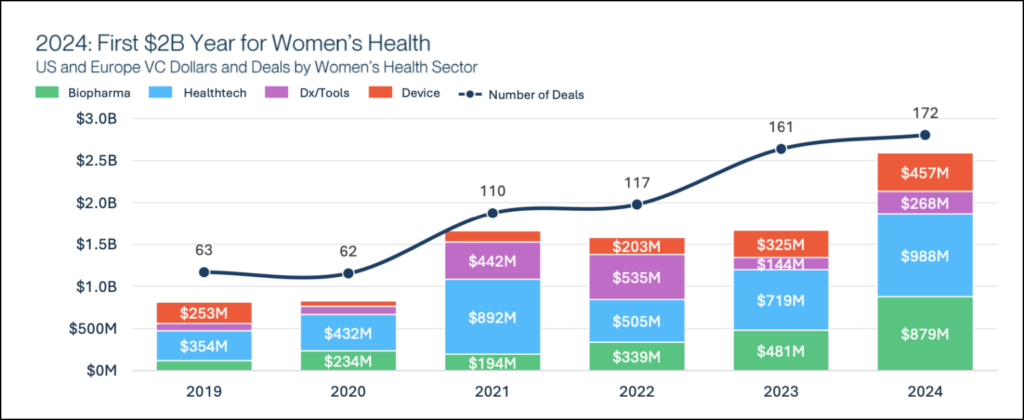
I couldn’t find a clear picture of funding in 2026, but one thing’s evident: the capital comes and goes. So, the brands that survive the swings are the ones that don’t rely on the momentum but build something underneath it.
AI has all players running around like headless chickens
AI sped up content production, but more than that, it removed the friction entirely. Every niche, including femtech, is now flooded with content that is well-structured, properly cited, and reads fine. It also says nothing that couldn’t have been generated by anyone, for anyone, about anything.
The bar for “publish-ready” dropped to the floor, and now everyone’s looking (read: arguing) for the bar for “worth reading,” “worth writing,” “worth ranking,” and “worth citing.”
Content censorship is still an uphill battle for femtech brands
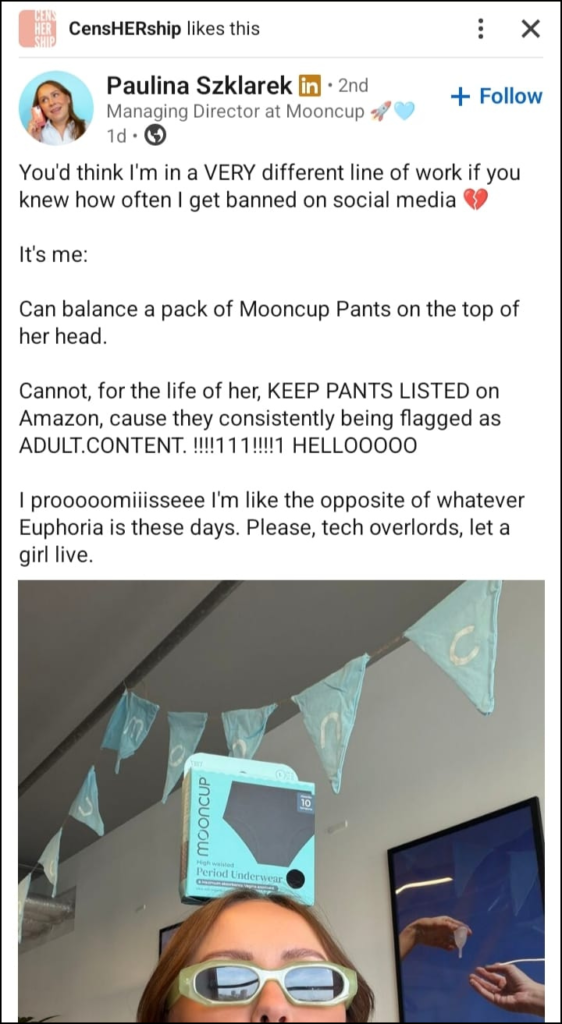
This one hasn’t moved much. Anatomical terms still trigger moderation filters. Medically accurate posts still get flagged as explicit. A CensHERship report found that 95% of women’s health content creators surveyed had experienced social media censorship in the past 12 months. And that was before Meta’s December 2025 content purge made headlines.
Censorship shapes what femtech brands can say, where they can say it, and how loud they can be. That was and is a content strategy problem, whether you want it to be or not. (This deserves its own piece, and it’ll get one.)
But the Basics Still Hold and I Bet They Always Will
Why that old article on femtech content marketing strategy is still relevant is that it was built on something that doesn’t change: human nature.
Ultimately, the target audience for any content is humans, and when we strip away all the tactics, what doesn’t change is how people are and how they receive information and trust.
People respond to honesty
When we stop thinking about emotional connection as a tactic, we realize it was always “the point.” What’s changed is that the noise is making it harder to fake.
Femtech audiences are not naive. They’ve been overpromised and underserved for so long that they’ve developed a very sensitive radar for content that’s performing care rather than practicing it.
Your ‘honesty tactics’ may get you clicks, but you cannot engineer your way to their trust.
A good story still travels further than a good keyword
This hasn’t changed, and I insist it can’t. Because storytelling is the oldest distribution strategy there is.
Stories were told and retold before humans ever knew how to write. That’s why, ever since I started my career a decade ago, I’ve struggled to work with clients who couldn’t see farther than the keyword.
Keywords matter for discovery and visibility, but it’s the stories that make the content sticky.
Femtech brands that lead with real stories, patient journeys and founders talking about the actual problem behind the product, are doing something no algorithm update can undo.
Your Native Expert or Data is the Moat Right Now
Citing reliable sources used to be enough. It signaled that you’ve done the research and you weren’t making things up. Your claim had legs to stand on.
In 2026, that’s the floor.
Everyone cites sources. AI cites sources. Half the time, AI invents them so convincingly that they can easily fall through the cracks if you’re not looking.
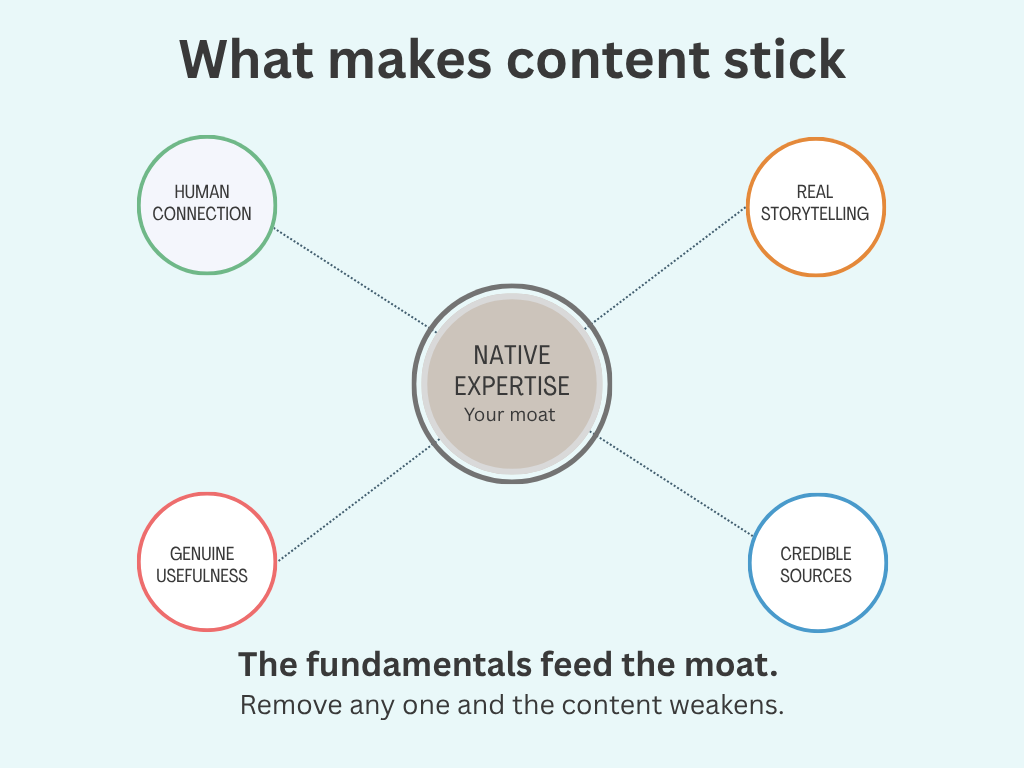
What actually builds differentiation now, especially in femtech, where the audience is informed, and the stakes are personal, is putting the people who actually know things in front of the content.
The era of adding expert credits in the footnotes, or “medically reviewed by” under the title, is behind us. Your native expertise needs to show up in the content itself. It should inform what you write and say, and speak directly to the audience through your content.
I saw this firsthand, witnessing the behind-the-scenes of the content production for Restore Hyper Wellness.
The content strategy was already solid, but when the brand’s science officer, the person in the room with clients and researchers every day, became the source, the team got its race engine. The entire dynamic shifted. The content changed, the authority changed, and with them, the way readers and search engines engaged also changed.
You can read the case study here.
Flo Health runs this at scale, with over 140 doctors curating and reviewing content for an app with 240 million downloads. Real medical expertise is central to everything they offer.
Not every brand has figured this out yet. Oli, an Australian medtech building a wearable that monitors maternal and fetal signals during labor, has a story with real stakes and real science that no competitor can replicate. But that story isn’t showing up in their content yet.
Gaia, a fertility financing platform, has a full content library, but read a few pages, and you’ll feel the absence of a real voice. It covers the topic, but it doesn’t tell you anything that only Gaia could tell you.
The femtech brands winning on content right now are the ones where you can feel that a real person, with real knowledge, had a real hand in what you’re reading.
Content marketing keeps morphing, and the femtech space will keep shifting too. But the piece I worked on in 2022 is still showing up, and that’s proof enough that human connection, real storytelling, or in other words, human-first content, is something no algorithm or AI can ignore.
Want a hand with your femtech content strategy?
1. What should a femtech content strategy focus on in 2026?
The brands standing out right now are the ones putting real expertise and real voices in front of their content. And the fundamentals still hold: human connection, storytelling, and usefulness.
2. How is AI changing content marketing for women’s health brands?
Volume doesn’t matter now since every brand can now produce good-enough content at scale. So, the differentiator is what you’re bringing to the content that AI can’t replicate on its own.
3. What kind of content works for femtech brands?
Content that takes the audience seriously. Femtech audiences have a sharp radar for content that shows real expertise. Think, patient stories, founder perspectives, clinician-backed education, honest takes on complex topics.
4. Should I use AI to write content for my femtech brand?
AI can be a useful part of the workflow. But femtech is a niche where accuracy is non-negotiable, and the audience can tell the difference between content written for them and content generated for anyone. If AI is doing the work without a knowledgeable human owning it, that gap shows.